
For generations, the beaches of North Norfolk were home to a distinctive type of wooden working boat - the crab boat. From the beaches of Weybourne through Sheringham and Cromer to Mundesley and Bacton, these sturdy clinker-built craft were launched directly into the North Sea to work the crab and lobster grounds offshore. Larger versions, known as whelkers, were built to carry more fishing gear and greater catches, operated from both beaches and harbours such as Wells-next-the-Sea.
These were boats shaped by necessity, their design refined over generations by the fishermen who worked them and the craftsmen who built them. Remarkably seaworthy, they were also beautifully proportioned, their graceful curves disguising the strength required to withstand the demands of operating from open, sometimes shingle, beaches.
Built by Eye and Experience
The Norfolk crab boat belonged to a centuries-old tradition of clinker construction; a method associated with Scandinavian and Viking boatbuilding. Its overlapping wooden planks produced a strong yet relatively light hull, capable of enduring considerable strain.
The design evolved to suit the conditions of the Norfolk coast. Broad in the beam, with a rounded hull and a pronounced upward sweep towards the bow and stern, the boats provided stable working platforms, well capable of carrying fishing pots and their catch.
Most were double ended, with curved stems and sternposts, their distinctive shape helping them negotiate the surf during often difficult launching and landings. Their relatively shallow draught was another advantage when operating from beaches - as opposed to harbours.
Unlike larger commercial vessels and those of the Royal Navy, these working boats were traditionally built without detailed drawings. The boatbuilders relied upon knowledge passed down through generations, a plumb-line and an experienced eye. Subtle alterations to the beam, depth or curvature of the hull were often made to suit an individual fisherman’s requirements.
North Norfolk’s Boatbuilders
Among the best-known craftsmen were the Emery family of Sheringham, whose boatbuilding tradition began around 1850 with Lewis Emery, a fisherman who turned to building boats himself.
His skills established a family business that continued through successive generations. Robert Emery, followed by Reginald and Harold Emery, helped develop and refine the traditional design as fishing methods changed.
Another prominent Sheringham builder was Johnnie Johnson, whose boats included the crabber Buddy, built in 1934, and the larger whelker Bessie, built the following year.
Later, Billy May of Potter Heigham became particularly well known for his Norfolk crab boats, producing numerous examples during the 1960s and 1970s. His boats retained the traditional clinker hull while incorporating improvements for motorised fishing.
Each builder brought his own judgement to the craft, yet all worked within a recognisable Norfolk tradition.
Oak, Larch and the Clinker Hull
The choice of timber was fundamental to the boat’s strength and longevity.
English oak was favoured for the keel, stem, sternpost and internal framing, while larch was commonly used for the hull planking. The overlapping planks, known as strakes, were secured with copper nails and roves, producing a strong but slightly flexible structure.
The curved internal ribs, called timbers, supported the hull, while substantial transverse seats, or thwarts, provided seating and additional strength. Fitted bottom boards created a working platform.
An eighteen-foot crabber might have two or three thwarts, leaving sufficient open space for fishing pots, ropes and the day’s catch.
Simple holes known locally as orricks were cut through the top planking for the oars, which could also be used to help lift and carry the boat.
Every component had a purpose. These boats were designed to be practical, durable and repairable, often remaining in service for decades.
A Fishing Fleet of Considerable Size
During the nineteenth century, crab fishing was a major occupation along the North Norfolk coast.
In 1875, Sheringham reportedly had around 100 crab boats, while Cromer had approximately 50, supporting hundreds of fishermen and their families.
The beaches would have presented an extraordinary sight, with rows of wooden boats hauled above the tide, their curved hulls resting together on the shore.
By 1951, the numbers had declined considerably. Sheringham had around 17 full-time fishing boats, Cromer nine, with smaller numbers operating from East Runton, West Runton and Mundesley.
The decline reflected changing economic circumstances and the gradual transformation of the fishing industry.
From Oars and Sail to Engines
During the nineteenth and early twentieth centuries, the smaller crab boats were propelled by oars and a simple dipping lug sail.
The sail reduced the considerable effort required to reach the fishing grounds, while oars remained essential for launching, landing and manoeuvring among the pots.
Launching demanded skill and cooperation. Fishermen pushed their boats towards the water, often using a long wooden pole known as a quant. The crew then rowed through the breaking waves, timing their departure carefully.
The arrival of small marine engines transformed the industry.
Engines began appearing in Norfolk crab boats during the early twentieth century, bringing new challenges for builders. The propeller and shaft required protection when boats were hauled across the beach.
Robert Emery is credited with developing a strengthened sternpost arrangement to protect the propeller, allowing the traditional beach boat to accommodate mechanical propulsion without losing its essential character.
Mechanical pot haulers eventually replaced much of the exhausting labour of hauling heavy crab and lobster pots by hand. This encouraged larger boats, stronger internal structures and more substantial working arrangements.
From Crabbers to Whelkers
The smaller beach-launched crab boats commonly measured between fifteen and twenty feet, although some later examples reached twenty-two feet or more.
Larger wooden whelkers, often around twenty-six to thirty feet, followed similar principles of clinker construction but were built to carry heavier loads and operate further offshore. These often operated from ports such as Wells-next-the-Sea.
Their greater size provided additional carrying capacity and improved endurance, while retaining the characteristic double-ended hull and traditional Norfolk appearance.
A surviving whelker Bessie, built by Johnnie Johnson in 1935, measures twenty-six feet and illustrates the close relationship between the smaller crabbers and their larger working relatives.
The Enduring Wooden Boat
By the 1970s, fibreglass construction was increasingly replacing traditional wooden boats. GRP hulls required less maintenance and could be produced more economically, while modern engines and hydraulic equipment continued to transform fishing.
Nevertheless, some wooden crabbers remained in service for many years, testimony to the quality of their construction.
Today, organisations such as Rescue Wooden Boats based in Stiffkey and Sheringham Museum help preserve surviving examples and the knowledge associated with their builders and those that sailed them. Traditional boatbuilders, including David and George Hewitt, have continued the skills of building, servicing and restoring these remarkable craft.
The Norfolk crabber represents an extraordinary example of practical design developed through generations of experience. Its sweeping sheer, overlapping planks and beautifully rounded hull produced a vessel of remarkable elegance.
Built without elaborate plans, shaped by the craftsman’s eye and tested by generations of fishermen, these boats remain among the most distinctive and enduring expressions of Norfolk’s - and Britain’s - maritime heritage.
Chris Kirby, Artist & Writer www.chris-kirby.co.uk
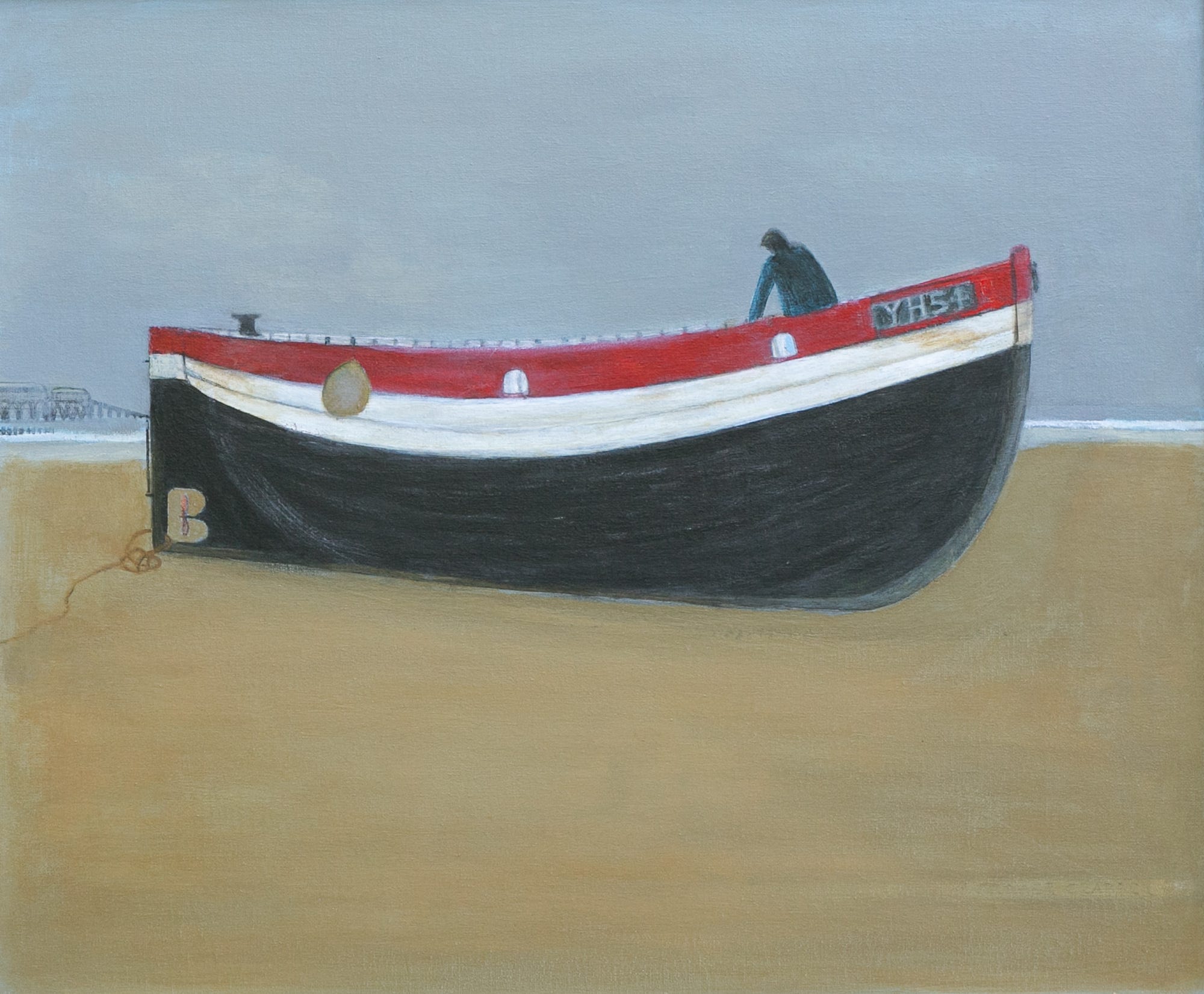
Cromer Crab Boat - a painting by Chris Kirby - illustrating a boat of larger size, with extended stern-post for propeller protection.